
webinar
You’ve seen this before. A new system launches with real momentum ,leadership is bought in, the vendor demo looked great, the rollout plan is solid. Six months later, half the team is back in spreadsheets, the new portal sits underused, and nobody quite wants to bring up how much the project cost.
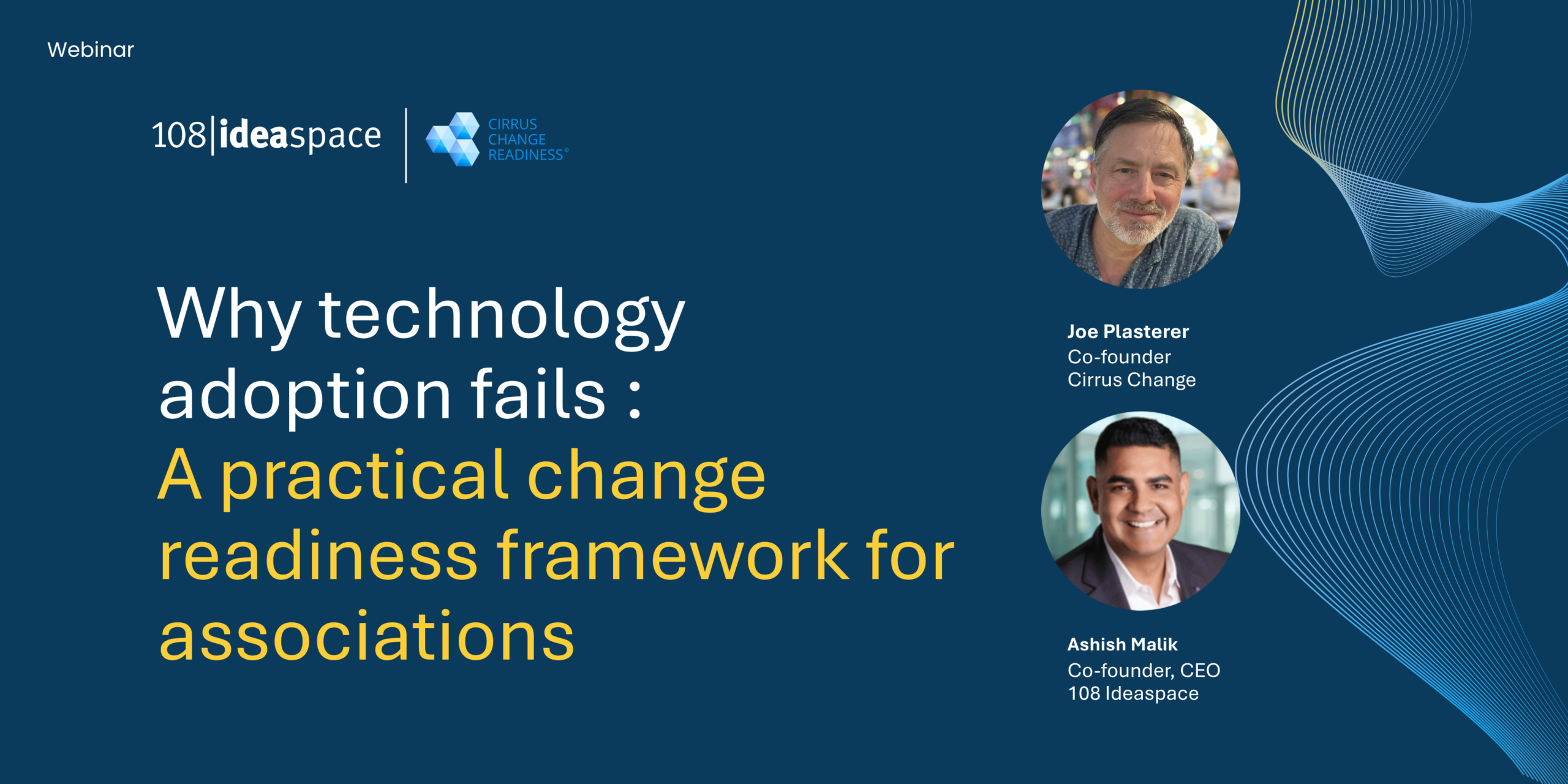
If that sounds familiar, you’re not alone, and you’re not doing anything unusually wrong. This was the exact problem tackled in a recent webinar hosted by 108ideaspace and Cirrus Change Readiness, featuring Joe Plasterer (Co-founder, Cirrus Change) and Ashish Malik (Co- founder & CEO, 108ideaspace). Their argument, grounded in both change management practice and hands-on association technology work, cuts against how most organizations diagnose these failures.
When a rollout underperforms, the instinct is to blame the platform. Maybe it was the wrong AMS. Maybe the vendor overpromised. Maybe procurement picked poorly.
Plasterer and Malik made the case that this diagnosis is usually wrong or at least incomplete. Most failed technology efforts fail because the organization wasn’t ready to change, not because the software was flawed. Staff reverted to old habits. Leadership assumed adoption would happen on its own once the system was live. Nobody built the internal case for why the change mattered before asking people to make it.
This is an uncomfortable reframe for association leaders, because it moves the responsibility away from the vendor and back onto the organization. But it’s also a more useful one. You can’t fix a tool that was never really the problem.
The framework introduced in the session wasn’t abstract change theory. It was a practical way to assess, before a rollout begins, whether the people and processes around a new system are actually prepared to use it. That includes things like: does staff understand why the change is happening, not just what’s changing? Are there internal champions who can model the new behaviour? Is there a realistic plan for the messy middle period between “old system” and “new system fully adopted”?
The key shift is timing. Most associations think about change management, if at all, after adoption stalls as a recovery effort. The framework treats readiness as groundwork, done before the contract is signed, not damage control done after.
Corporate change management playbooks don’t always translate cleanly to the association world, and the webinar was direct about why. Association and nonprofit teams tend to be small, with staff covering multiple functions and little slack to absorb a rocky transition. Institutional knowledge often lives in people, not documentation, which makes change feel personal rather than procedural.
And unlike an internal-only system, association technology is often member-facing. A clunky renewal flow or a confusing new portal doesn’t stay behind the scenes members notice immediately, and their patience for friction is limited. That visibility raises the stakes on getting readiness right the first time.
Most technology decisions start with the same question: which platform should we choose? It’s a reasonable question, but it’s the wrong one to ask first.
The more useful question, and the one this webinar kept circling back to, is: is our organization actually ready to change? That’s a harder question to answer honestly, because the answer isn’t found in a vendor comparison sheet , it’s found in how your team handled the last change, and whether anyone actually prepared them for it.
For association leaders evaluating a new AMS, CRM, or member portal this year, that question is worth sitting with before a single demo gets scheduled.
You don’t need a full change management department to start building readiness. You need an honest look at how your organization handles change today, and where the gaps actually are.
If this resonates with something you’re navigating, we’d welcome the conversation. Reach out to 108ideaspace to talk through what change readiness could look like for your organization, no pressure, no sales pitch attached.
Because the real risk in your next technology decision probably isn’t picking the wrong platform. It’s assuming a good one will do the readiness work for you.